
Your doctor is someone you trust. Implicitly. So imagine the horror of seeking help for a severe ailment, only for an intoxicated man with no medical training to sit down and pull out a scalpel.
Unbelievably, and tragically, that’s exactly what happened in the Barabanki district of Uttar Pradesh, India. Sadly, the victim, 38-year-old Munishra Rawat, would quickly pass away.
Unbelievably, and tragically, that’s exactly what happened in the Barabanki district of Uttar Pradesh, India. Sadly, the victim, 38-year-old Munishra Rawat, would quickly pass away.
But how did it come to this? This is another brutal reminder that when power is exploited for profit, ordinary people pay the price.
Abdominal Pains Strike
Munishra Rawat lived with her husband, Tej Bahadur (also known as Fateh) Rawat, a labourer, in the village of Dasrapur, in the Kotwali Kothi area. She had three young children.
Munishra and her husband belonged to the Dalit community, a group historically excluded from India’s caste system.
Although the Indian constitution outlaws caste-based inequality, Dalit families often have less access to power, fewer connections to authorities, and a limited ability to challenge local figures.
That power imbalance was a fundamental part of what happened next.
Everything about the couple’s life was normal until Munish started experiencing severe stomach pain in early December 2025. She was in a lot of pain, and the couple needed to act fast.
Shri Damodar Aushadhalaya
Back in 2018, Munishra had experienced a similar abdominal pain. Tej Bahadur took her to a doctor, who performed an ultrasound and discovered a gallbladder stone. The pain eventually left on its own. Now, seven years later, she was experiencing similar pains once again.
So, on Wednesday, December 4, Tej Bahadur brought his wife to a nearby clinic, Shri Damodar Aushadhalaya. It was about two-and-a-half miles away, and run by a 48-year-old man named Gyan Prakash Mishra, with assistance from his nephew, Vivek Kumar Mishra.
Gyan was the former Pradhan. A Pradhan is a regional title used in parts of Northern and Central India, including Uttar Pradesh. It’s used for the elected head of a village-level local government. In effect, then, Gyan was the former village chief.
Even though most of the village was aware that Gyan had little in terms of medical qualifications (a ‘quack’, in informal terms), his former position meant he was trusted to do the right thing. Besides, his nephew and assistant, Vivek, worked at an ayurvedic hospital in Raebareli.
Ayurvedic vs. Allopathic
Ayurveda is India’s traditional system of medicine, formally recognized by the state. It focuses on herbal remedies, diet, and non-invasive treatments rather than modern surgery, but its practitioners are still commonly referred to as doctors.
In contrast to Ayurveda, allopathic medicine is the term commonly used in India to mean modern, Western, evidence-based medicine. However, for many families, an ayurvedic hospital is just what they’re looking for, as in the case of Munishra Rawat.
But just because Vivek Mishra worked at an ayurvedic hospital doesn’t mean he or Gyan were familiar with abdominal surgery. To Tej Bahadur and Munishra’s horror, they were about to discover just that.
Why Go to an Informal Clinic?
Government health centers in rural Uttar Pradesh are often understaffed, far away, or open only for limited hours. Private hospitals do exist, but they’re expensive, unfamiliar, and intimidating.
Instead, many people – especially Dalits – turn to informal practitioners and clinics, like Shri Damodar Aushadhalaya. Here, they get immediate access to healthcare and treatment at a fraction of the cost of private hospitals, all from familiar local faces.
That’s why many people like Tej Bahadur and Munishrachoose to place their trust in these so-called doctors, even when they quietly know the risks of working with a ‘quack’.
Gyan advised an ultrasound and felt around Munishra’s abdomen. After reviewing the results, he was immediately sure that the problem was gallbladder stones, and told the couple that Munishra required immediate surgery, which would cost ₹25,000 (about $300 USD).
The Decision
It was now Thursday, December 5. Tej Bahadur and his wife felt hesitant. Gyan hadn’t done any additional tests on Munishra, and alarmingly, he reeked of alcohol, appearing drunk. He had called for other doctors, but none had shown up. Gyan assured the couple he could do the surgery himself – he had learned it on social media.
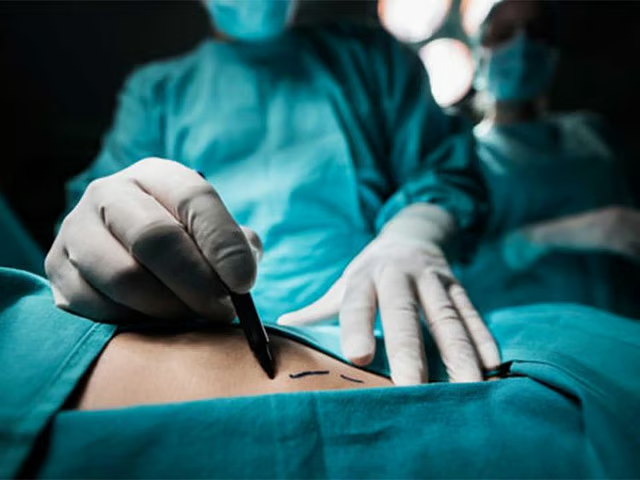
Such claims would raise anyone’s eyebrows. And yet, Munishra was in intense pain, and Gyan said that any delay might be fatal. Besides, he was a former Pradhan, and Vivek worked at the ayurvedic hospital, so they decided the risk was worth it.
And so, the couple managed to collect ₹20,000 – all they had available. Gyan told them that was enough. They paid him then and there, and the surgery began.
But what happened next left Tej Bahadur terrified and sick to his stomach. Because the apparent doctor pulled up a YouTube video. And only then did he make the first incisions.
The Tragic YouTube Surgery
Tej Bahadur watched in horror as Gyan Mishra sliced deeply into his wife’s abdomen to begin the surgery. He immediately realized that neither Gyan nor Vivek had any idea where to make the incisions, nor how to handle the bleeding that quickly erupted.
As a local villager would later tell the News18 outlet, “It was clear [Gyan and Vivek] were improvising.”
The cuts they had made were far too deep. They had sliced through major veins and nerve pathways, and were utterly unprepared for the inevitable complications that immediately arose.
But the surgery had started now, and there was no going back.
Into the next day, December 6, Munishra remained in the clinic, with Gyan and Vivek frantically trying to “manage” the situation.
Later in the afternoon, Tej Bahadur returned home to wash. Here, he had a call from the clinic that his wife’s condition had deteriorated rapidly, and he should come back immediately.
Sadly, Munishra would pass away at around 6 p.m. Tej Bahadur didn’t make it in time to be with her.
Protest for Justice
After Munishra’s death, Tej Bahadur alleged that Gyan and Vivek tried to bribe him, offering him money to keep his mouth shut and bury the matter. Incensed even further, he refused and took his wife’s body away.
Around five hours later, approximately 11 p.m., her outraged family, friends, and neighbours placed her body across the road, blocking the traffic through the village. They demanded immediate action against the two men who, thanks to their negligence, had taken this young woman’s life.
Police were, naturally, called to the location, and after several hours, managed to persuade the family to lift the blockade, assuring them that an investigation would be launched and that the men would be brought to justice. It was, by this point, early on Sunday, December 7.
After consenting to this, Fateh and the family allowed Munishra’s body to be taken for a postmortem examination. Here, it was established that a possible reason for her stomach pain was appendicitis, not gallbladder stones, and that the surgical complications had at least significantly contributed to her death.
Untouchable Position of Power
The fact that Gyan Mishra was a former Pradhan meant he could run the clinic with very little fear of reprisal from anyone around him, even though many knew he lacked the necessary medical experience or qualifications.
His nephew, Vivek, was no less guilty. He used his job at the ayurvedic hospital to give the fraudulent clinic the appearance of legitimacy. However, he too had no medical qualifications.
Under the cover of his government job, the clinic had been open and operational for years before this incident. Shri Damodar Aushadhalaya had no authorization or registration to operate.
Everyone knew about Gyan’s past position of authority, and concern remained that the local Kothi police force might not intend to prosecute Gyan or Vivek. The Bahujan Army, a grassroots Dalit-led social justice activist group, would hastily get involved.
What Happened Next
As such, on Monday, December 8, hundreds of Bahujan Army members surrounded the Kothi police station, accusing authorities of long-running negligence and corruption that allowed illegal clinics to operate unchecked, and demanding that justice for the family – and for the Dalit community as a whole – not be delayed or quietly abandoned.
In part thanks to this pressure, the Medical Superintendent of the Kothi Community Health Centre, Dr. Sanjeev Kumar, declared the clinic illegal the next day, Tuesday, December 9. The notice was pasted, and the Shri Damodar Aushadhalaya Clinic sealed.
The Kotwali Kothi police department then registered an FIR (First Information Report) – the formal document that starts a criminal case in India. As of the most recent updates, a case of death by negligence has been filed, along with charges under the SC/ST (Prevention of Atrocities) Act, 1989.
According to Inspector Bhadhoriya, both Gyan and Vivek, though, are “accused of absconding, and teams have been deployed to track them down.”
They locked their fraudulent clinic behind them and went on the run. At the time of writing, that manhunt is still underway, with neither Gyan nor Vivek found or brought back for justice.
The men who abused that power have, at least for now, escaped justice for abusing the Dalit community’s trust and for allegedly taking the life of Munishra Rawat. And it’s that kind of corruption that should be a warning for us all.



Leave a comment