
Bahia Bakari was an ordinary twelve-year-old girl from Evry, outside Paris. She lived with her three younger siblings and her parents, Kassim and Aziza.
Nothing about her life was any different from that of her friends, and she was excited about an upcoming trip with her mother.

She would never have known it, but that trip would irreversibly change her life, and she would be forever known as the ‘miracle girl’.
Leaving Paris for the Comoros
On June 29, 2009, twelve-year-old Bahia Bakari and her mother headed to the airport in Paris.
They were taking a vacation to the small island of Grande Comore, which houses Moroni, the capital city of the Comoros Islands, off the east coast of Africa between Mozambique and Madagascar.
Bahia was looking forward to staying with her grandmother for her grandfather’s wedding. It was an exciting time for her and her mother.
Kassim took them both to the airport and kissed them goodbye. Aziza, Bahia’s mother, turned to wave as they entered the airport.
It was an innocent and exciting time for everyone. Nobody could have imagined it would end in such a tragic way.
Change of Aircraft in Sana’a
The flight would consist of two legs. The first, from France to Yemen, was on board an Airbus A330.
That part of the journey went smoothly. Once the plane landed in Sana’a, Yemen, Bahia and her mother disembarked and transferred to another plane to begin the final leg to Moroni. The flight number was Yemenia 626.
The plane departing Yemen for Comoros was a nineteen-year-old Airbus A310. It wasn’t in great condition; flies buzzed around, and it smelled like a bathroom. But Bahia and her mother weren’t too worried.
The plane took off, and Bahia and her mother were on their way to visit their family in Moroni.
Descent into Turbulence
Despite the uncomfortable conditions, the journey continued without concern. The pilots began the descent into Moroni not long after midnight on June 30. But then, everything changed.
Bahia felt the turbulence get worse and worse. She looked around, but nobody seemed overly concerned, so she relaxed for a moment. A feeling like an electric shock suddenly jolted through her body. Then nothing.
Bahia awoke, surrounded by choppy, turbulent water. She couldn’t feel anything, but as she floated there, she regained her senses. She was weak and in shock and had no life vest.

It didn’t take her long to realise that the worst thing imaginable had happened. The plane had crashed into the ocean.
Around her, she could hear women screaming and crying in Comorian, but she couldn’t see anyone. She tried shouting for help herself, but without being able to see anyone, she didn’t know what else she could do.
Her mother was also nowhere to be seen. In desperation, Bahia looked around and saw wreckage from the plane. She swam over and tried to climb on, but couldn’t. She was too exhausted. Instead, she clung to it as the taste of jet fuel filled her mouth.
As she held on, the wreckage drifted further and further away from the crash site. The screams grew quieter and more distant, eventually fading altogether.
She was alone in the middle of the Indian Ocean. As she clung on for dear life, she had no idea if her mother had survived – and didn’t expect to herself.
The Rescue
Drained, Bahia fell asleep clinging to the wreckage. When she awoke, she could see the coastline. She was still clinging on, still thinking of her mother – and that gave her the strength to keep going.
A merchant marine from Madagascar, Doe Cyrille, had taken his crew to follow the distress signal from the plane. They had been scouring the waters for hours in 16-foot waves.
Suddenly, impossibly, they saw a girl trying to climb onto a piece of floating debris. It was Bahia.
They sailed close and threw her a life preserver, but Bahia was too weak to swim to it. But she remained calm.
One of Cyrille’s sailors, Libouna Maturaffe Soulemane, jumped into the raging waters with another flotation device. When the crew threw the buoy again, both he and Bahia grabbed hold, and they were pulled aboard to safety.
On the boat, the crew tried to get Bahia to remove her clothes so they could get her dressed in something dry – but, shyly, she refused. Instead, they wrapped her in blankets and gave her a warm, sugary drink.
Taken to Moroni
It was 4:25 pm by the time Cyrille’s boat, the Sima Com 2, made it back to Port Moroni, over thirteen hours since the crash.
She was immediately taken to El Maaruf Hospital in Moroni. Incredibly, apart from hypothermia and terrible trauma, Bahia’s only injuries were a fractured collarbone and bruises to her face, elbow, and foot.
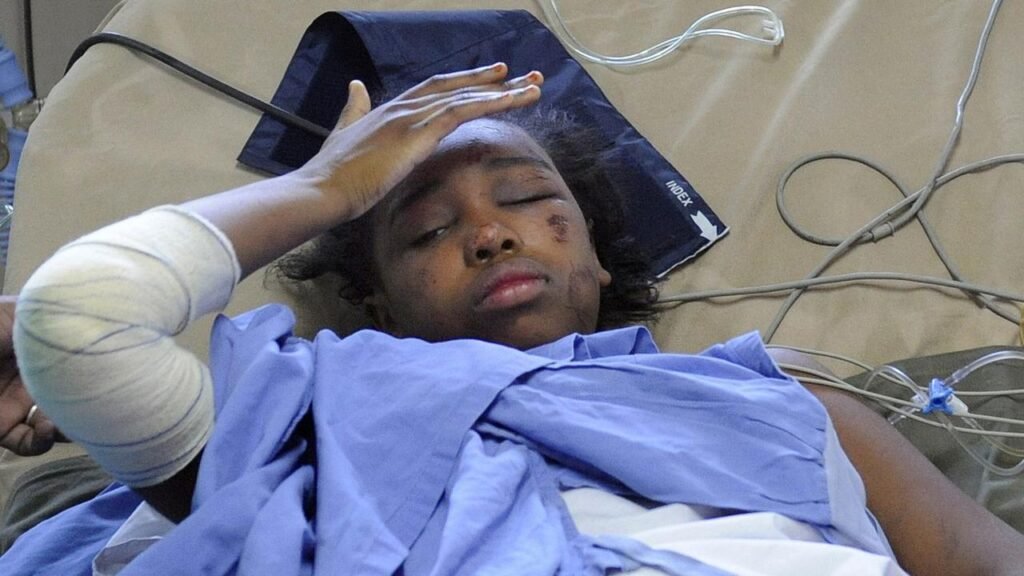
But she didn’t yet know the terrible truth. She believed she had been “the only one who fell”, and that everyone else on the plane had been rescued. For a while, Bahia lay in her hospital bed. She asked for nothing, except to see her mother.
Her family feared she was too traumatized to be told her mother was almost certainly dead. Instead, they told Bahia that her mother was just in the next room.
Eventually, though, when she had recovered enough, a psychologist came to see her and told her that her mother most likely did not survive. And in fact, nobody else did; Bahia was the sole survivor of 153 people on board.
Bahia was very close to her protective mother, and that grief was hard to stomach. Her father and her siblings back at home would miss her so much, and she couldn’t be that person for them.
Back Home to France
Bahia was transported from the hospital in the Comoros back to France on Thursday, July 2, on board a chartered Falcon-900 jet equipped with medical facilities.
At Le Bourget airport, her father, Kassim, who had been terribly worried, met her before she was taken to the Armand-Trousseau Children’s Hospital. There, she underwent facial and skin surgery, but was impatient to leave and get home.
Three weeks later, she was discharged from the hospital around July 23, 2009.
Investigation and Accountability
The remains of 27 of the victims were found over the following weeks and months. Eventually, authorities also found the plane’s black box – but the investigation by Comorian and French authorities took years, with France accusing Comoros of delaying the process.
Eventually, it was determined that the plane itself had been perfectly operational. It had crashed into the Indian Ocean with its engines running at full throttle.
In fact, the crash which claimed Bahia’s mother’s life – and the lives of 151 others – was caused by “inappropriate actions by the crew during the approach to Moroni airport, leading to them losing control”.
How the Crash May Have Happened
Some reports suggest that air traffic control instructed the pilots to change course due to the strong wind. Controllers lost contact with Flight 626 just after receiving notification that it was coming in to land.
The long runway at Prince Said Ibrahim International Airport on the island of Moroni was considered sufficient. Still, many airlines provided pilots with special training to safely land there.
It was also dark, and pilots were supposed to land visually. Of course, that was impossible – especially because the landing strip lights sometimes malfunctioned.
Investigators later determined that the accident occurred because the pilots were unable to maintain a stable altitude during the circle-to-land approach. As the aircraft faltered, it entered a stall and ultimately plunged into the ocean.
A French court found Yemenia Airlines guilty of involuntary manslaughter in 2022, and it was ordered to pay a €225,000 fine alongside €1,000,000 to Bahia and the families of 64 French citizens who died.
Regardless of who was to blame, the tragedy had happened. And nothing could change it.
Survivor’s Reflection
It was over twelve years before Bahia, who became known as the “miracle girl,” testified in court over the incident. Yemenia Airlines was not present, due to the ongoing civil war in Yemen.
For Bahia and the families of the 152 victims, that felt like an insult. But there was nothing more that they could do. In one terrible tragedy, the survival of this one twelve-year-old girl was a miracle.
The most incredible part? Despite a full-throttle plane crash into the Indian Ocean in stormy conditions and rough seas, Kassim Bakari described his daughter, Bahia, as a fragile girl who could barely swim.
Sources
https://www.theguardian.com/world/2009/jul/02/yemen-air-crash-girl-speaks








Leave a comment